





The 1xBet anti-fraud system combines identity checks, payment controls, and ongoing account review. It examines account data against financial activity and submitted verification records. These checks help detect identity misuse, third-party payments, suspicious transfers, and duplicate accounts. Pakistani and Bangladeshi users may face extra verification before selected financial operations. PKR and BDT transactions remain subject to the payment options shown inside each account.
Legitimate users can reduce interruptions by keeping profile and payment details consistent. Deposits should come from payment methods owned by the registered account holder. Requested KYC documents must remain current, readable, and unaltered. Unusual activity can trigger a manual review or temporary financial restriction. Cooperation with the Security Department usually requires accurate documents and clear answers.
How the Anti-Fraud System Works
1xBet applies identity verification, customer due diligence, transaction monitoring, and account-level risk controls. The published AML rules state that financial and gaming activity may be reviewed automatically and manually. Checks can cover transaction size, frequency, source of funds, account ownership, and unusual activity. Additional screening may apply when the account shows elevated risk indicators.
For users in Pakistan and Bangladesh, the practical rule is simple. Keep registration details, identity records, and payment ownership aligned. Pakistan-facing materials state that withdrawals require KYC and may take 24–72 hours for standard document review. Bangladesh-facing pages also state that identity and payment-method verification may be requested before withdrawal.
PKR or BDT payments should use methods listed in the cashier for that specific account. A payment option can have its own limits, processing rules, and verification steps. The anti-fraud process does not guarantee immediate approval. It checks whether the transaction fits the account holder’s verified profile and platform rules.
Main protective layers include:
- identity and age verification;
- payment-method ownership checks;
- transaction and betting activity review;
- source-of-funds checks when requested;
- duplicate-account and third-party-payment controls;
- manual review when automated checks raise concerns.
KYC verification and Enhanced Due Diligence
KYC confirms that the registered account belongs to the person using it. Standard checks may compare legal name, birth date, residential address, phone details, and identity documents. 1xBet can request a government-issued photo ID, recent proof of address, a selfie, payment evidence, or source-of-funds records. EDD applies when higher-risk indicators appear, including unusual transactions, larger cumulative activity, third-party payment signs, sanctions concerns, or higher-risk jurisdictions. Successful verification can restore access to restricted financial functions, including withdrawals where available in PKR or BDT.
Usual verification material:
- Government-issued photo ID, such as CNIC, passport, or national ID.
- Proof of address, commonly a recent utility bill or bank statement.
- Selfie or live image when account ownership needs extra confirmation.
- Payment-method evidence showing that the account holder controls the method.
- Source-of-funds or banking records when risk checks require them.
Pakistan-facing KYC materials state a typical review period of 24–72 hours. More complex reviews can take longer because additional documents or payment checks may be required. Public rules do not promise one fixed completion time for every case.
Behavioral monitoring and transaction screening
1xBet states that financial and gaming activity can be monitored through automated and manual controls. The review looks for activity that differs from ordinary account use or conflicts with submitted identity data. Normal activity usually involves personal payment methods, consistent profile details, ordinary betting use, and withdrawals linked to verified deposits. Higher-risk patterns include third-party funding, repeated deposit-withdrawal cycles without normal betting, mismatched sender details, unusual transaction sequencing, or abrupt changes requiring further review.
| Lower-risk account habits | Patterns that may trigger review |
| Use payment methods in your own name | Use another person’s card, wallet, or payment account |
| Keep profile data consistent | Change key identity details without clear reason |
| Deposit and bet normally before withdrawal | Deposit and request withdrawal with little or no betting |
| Follow the cashier’s stated payment route | Switch between unrelated payment methods repeatedly |
| Submit requested documents promptly | Ignore or refuse verification requests |
| Keep account access personal | Share access or operate duplicate profiles |
Common triggers that lead to account restrictions
Account restrictions usually follow a mismatch between expected account ownership and observed activity. Published 1xBet rules allow extra checks for unusual transactions, identity concerns, third-party payment methods, duplicate accounts, or suspicious financial behavior. A new device or location is not publicly listed as an automatic violation by itself. It can still prompt an ownership check when combined with other irregular signals. PKR and BDT users should treat sudden payment changes carefully and keep ownership evidence ready.
Frequent triggers include:
- personal data that does not match submitted documents;
- deposits from payment details belonging to another person;
- withdrawals through a different method without required verification;
- repeated deposits and withdrawals with minimal betting activity;
- unusual transaction frequency, size, or sequence;
- duplicate accounts or third-party account use;
- refusal to provide requested KYC or source-of-funds documents;
- altered, expired, unreadable, or inconsistent verification files.
What to Do If Your Account is Blocked
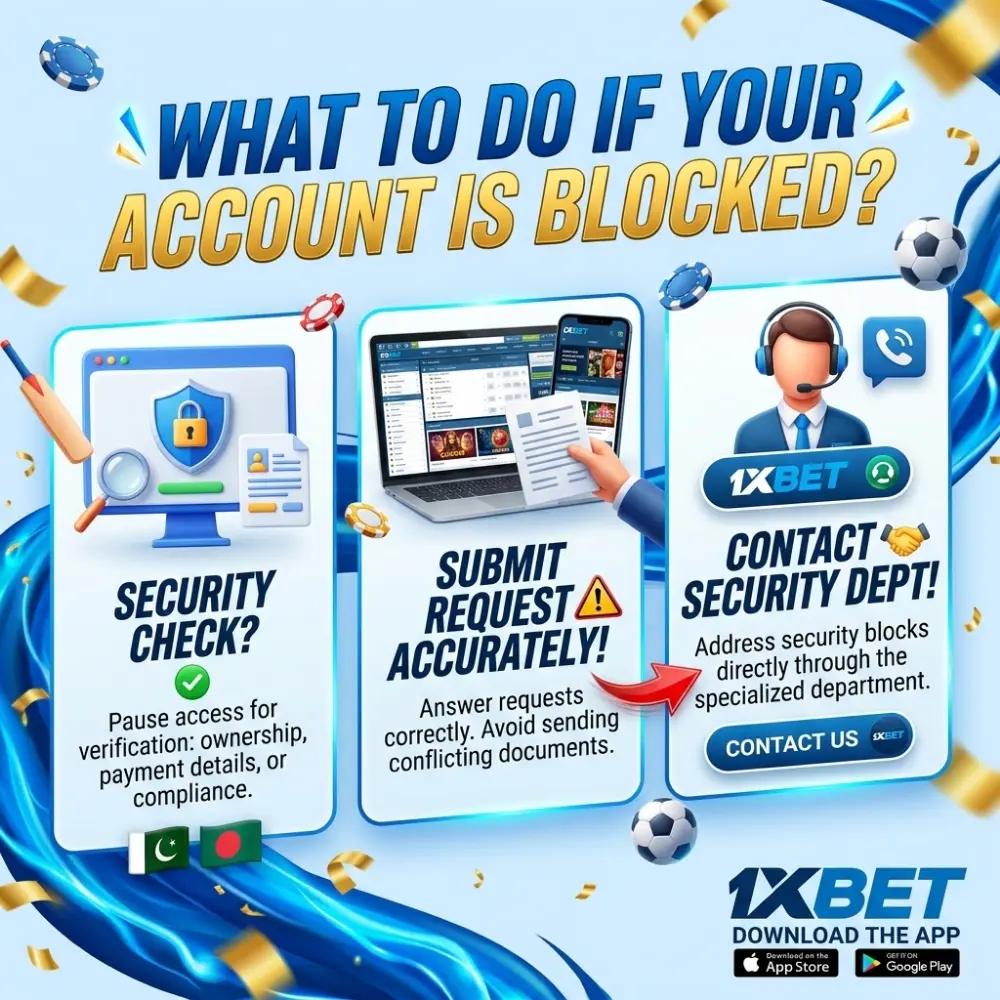
A temporary restriction does not always mean permanent account closure. Security checks can pause access while 1xBet confirms ownership, payment details, or compliance information. Users should answer requests accurately and avoid sending conflicting versions of the same document. Security-related blocks can be addressed through the Security Department.
Immediate actions:
- Check the registered email address and spam folder for a security request.
- Read the request carefully and identify every required document.
- Gather clear originals or permitted digital copies without editing them.
- Prepare a concise explanation of the disputed payment or account activity.
- Contact the Security Department using the official address for security cases.
- Keep copies of submitted files and correspondence until the review ends.
Typical reasons for freezes and verification requests
A freeze can occur when 1xBet needs more evidence about identity, payment ownership, transaction origin, or account use. Common cases include unfinished KYC, sender details that differ from the registered name, third-party payment methods, unusual transaction sequences, duplicate profiles, or activity that conflicts with earlier account behavior. A sudden change in betting volume may contribute to a review when combined with financial or identity anomalies. PKR or BDT amounts alone are not publicly described as automatic block triggers.
Common reasons:
- Incomplete or failed KYC verification.
- Mismatched name, birth date, address, or payment details.
- Third-party deposits or withdrawals.
- Unusual deposit and withdrawal sequences.
- Duplicate-account indicators.
- Requests for source-of-funds evidence that remain unanswered.
How to contact the Security Department and resolve the issue
For a blocked account, use the official Security Department email: [email protected]. State the account ID, registered contact details, date of the restriction, and a short factual description. Attach only the documents specifically requested. Files should be genuine, readable, current, and unaltered. Do not send a second version with changed details unless the Security Department asks for it. 1xBet does not publish a fixed Security Department response time, so users should not assume a guaranteed number of hours.
Recommended contact sequence:
- Check the restriction notice and registered email first.
- Write to [email protected] from the registered email address.
- Include the account ID and a short description of the issue.
- Attach the requested ID, address, payment, or funds evidence.
- Answer follow-up questions using the same verified information.
- Use official customer support for status assistance when needed.
Important tips to avoid anti-fraud blocks
Consistent account ownership is the strongest preventive habit. Use your real personal details and keep them aligned with identity records. Pay from methods you control, especially when depositing or withdrawing in PKR or BDT. Avoid moving money through the betting account without ordinary betting activity. Complete verification when requested and keep proof of payment ownership available. If a legitimate change affects your profile or payment route, explain it clearly when support requests details.
Preventive checklist:
- Use one personal account only.
- Enter legal identity details correctly.
- Keep phone and email access under your control.
- Use payment methods belonging to you.
- Avoid third-party wallets, cards, or bank details.
- Do not edit verification documents.
- Respond to KYC requests without unnecessary delay.
- Keep payment receipts when a transaction may need verification.
- Follow the withdrawal route shown in your account cashier.
- Contact security staff when a restriction notice specifically requests it.
Conclusion
The 1xBet anti-fraud process focuses on identity, payment ownership, transaction history, and account consistency. Pakistani and Bangladeshi users can reduce avoidable reviews by completing KYC accurately and using personal payment methods. Extra checks may request proof of address, payment ownership, or source of funds. Temporary restrictions can remain active while those records are examined. For blocked accounts, the correct route is the official Security Department and truthful supporting documents. These habits help legitimate PKR and BDT activity match the verified profile and reduce preventable payment interruptions.